





In the context of the full‑scale war, Ukrainian companies are increasingly viewing the outsourcing of financial, accounting, tax, and payroll functions to external experts as an integral part of their operational and compliance risk management framework. Power supply disruptions, staff relocation, talent shortages, cyber threats, and high regulatory volatility have created an environment in which dependence of the finance function on specific individuals, locations, or infrastructure has become critical to business continuity.
Engaging a professional outsourcing provider that operates under a team‑based delivery model, supported by standardised procedures, back‑up resources, and digital solutions, enables companies to strengthen operational resilience, improve the quality of financial information, and enhance their readiness to interact with banks, investors, and international partners.
This article examines how outsourcing helps mitigate war‑related, talent, compliance, and cyber risks, and outlines practical approaches to building an effective governance model, as well as key criteria for selecting a reliable outsourcing partner in the context of Ukraine’s economic recovery.
Ukrainian businesses are operating in some of the most challenging conditions in Europe. Beyond the core financial management tasks — taxation, reporting, payroll, currency transactions, cost control, and management reporting — companies now face risks that only a few years ago seemed exceptional. These include missile attacks, power outages, disruptions to internet and mobile communications, staff relocation, talent shortages, mobilisation, damage to office premises, cyber threats, and the constant need to rapidly adapt to new and evolving regulatory requirements.
In these circumstances, outsourcing financial, accounting, tax, and payroll functions is no longer just a cost‑optimisation tool. For many companies in Ukraine, it has become a core element of operational resilience — a way to ensure the continuity of critical processes even when parts of the team, infrastructure, or established business workflows are temporarily unavailable.
Amid ongoing war‑related challenges, energy instability, and constant regulatory change, Ukrainian businesses are increasingly viewing professional outsourcing not merely as a cost‑efficiency measure, but as a strategic tool for operational resilience. Delegating financial, accounting, payroll, and compliance functions to external experts enables companies to reduce talent, operational, and cyber risks, maintain the continuity of critical processes even during power outages or team relocation, and enhance both the quality of financial reporting and overall readiness to work with investors, banks, and international partners.
From fixed costs to a flexible and controlled delivery model
In peacetime, companies often viewed outsourcing primarily as an alternative to maintaining a full in‑house finance team. In the context of war, this perspective has significantly evolved. Today, businesses need more than just cost reduction related to salaries, training, staff replacement, software, and team management. What matters is a flexible, scalable model that can support processes during peak workloads, ensure continuity, and operate independently of the physical location of individual employees or offices.
Outsourcing allows a company to gain access to a team of specialists with diverse expertise: accounting, taxation, payroll projects, IFRS, management reporting, internal control, and automation. This is particularly important for small and medium‑sized businesses, where one person often combines several critical roles. When such a person relocates, becomes ill, is mobilised, loses access to electricity, or is simply overloaded, the work of the finance function may come to a halt.
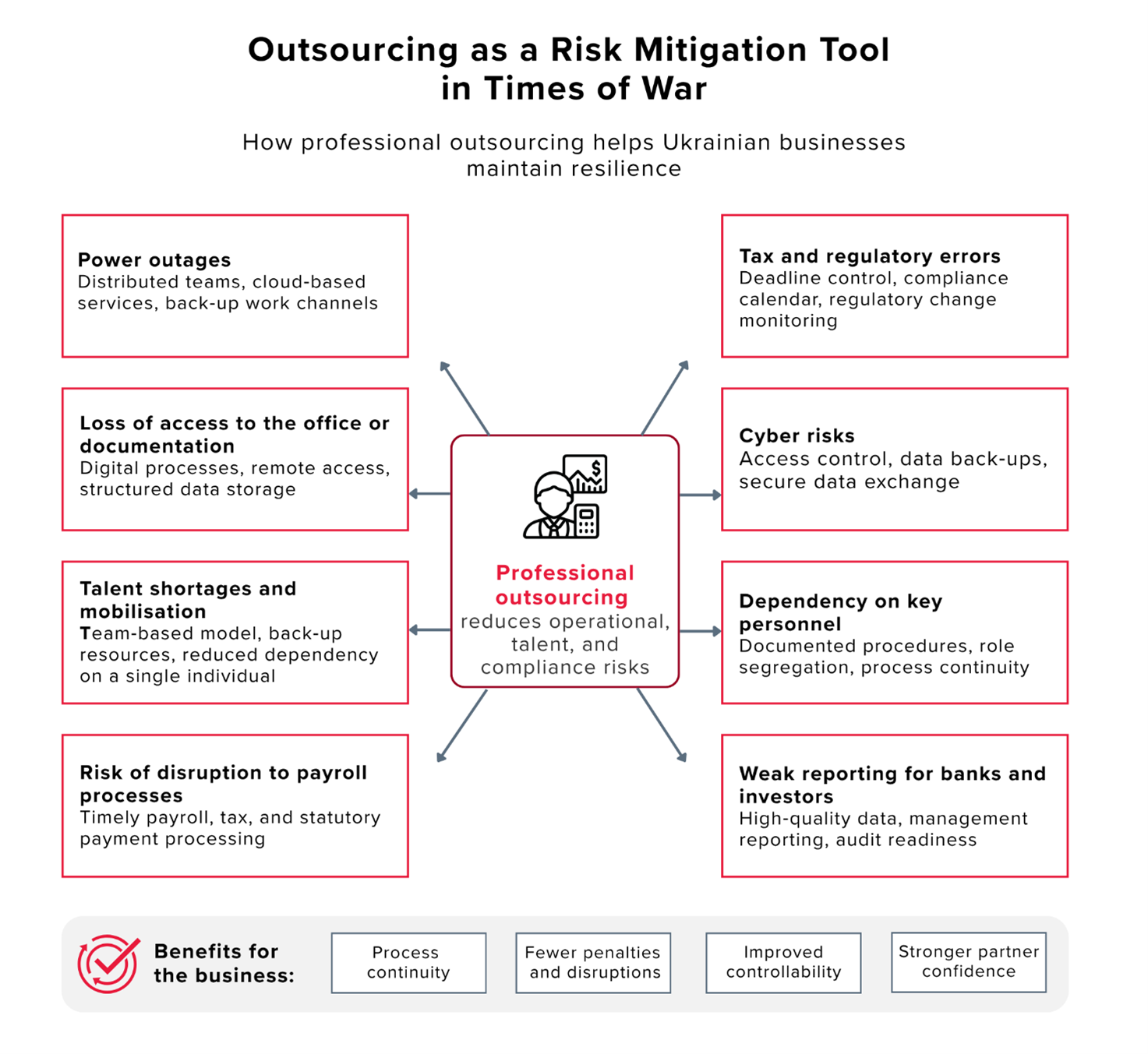
Professional outsourcing reduces this risk through a team‑based model, documented processes, clear allocation of roles, and back‑up resources.
Power outages as a financial risk
For Ukraine, energy instability has become a separate critical factor. Systematic attacks on energy infrastructure have caused emergency power outages across many regions, as well as disruptions to heating, water supply, and communications. In February 2026, the United Nations reported that repeated attacks on Ukraine’s energy infrastructure were causing significant power supply disruptions and worsening living conditions for the civilian population.
For businesses, this is not merely a day‑to‑day inconvenience. A lack of electricity can result in delayed month‑end closing, late submission of tax reporting, inability to register tax invoices, disruptions in payroll processing, and loss of access to source documents, banking services, or ERP systems.
A professional outsourcing provider mitigates these risks through a distributed delivery team, back‑up communication channels, cloud‑based solutions, standardised period‑closing schedules, strict deadline control, and the ability to rapidly mobilise alternative resources. While this approach does not eliminate external risks entirely, it significantly reduces the likelihood that a single local disruption will halt the company’s entire finance function.
In the Ukrainian context, this delivers clear compliance value. The Ministry of Finance of Ukraine has issued guidance on how to confirm an inability to meet tax obligations during power outages or other extraordinary circumstances, including delays in reporting or the registration of tax and excise invoices. Nevertheless, relying solely on mechanisms to justify missed deadlines is not enough — a resilient operating model helps prevent such disruptions from arising in the first place.
Reliable financial information in an environment of uncertainty
During the war, management decisions often need to be made much faster than in a stable environment. Companies must have clear visibility over actual liquidity, receivables, foreign exchange risks, cost structure changes, and margin impacts — including the effect of generators and logistics — as well as expenses related to security, relocation, insurance, back‑up equipment, and personnel.
When financial information is generated with delays or contains errors, management is running the business “in the fog”. This is particularly dangerous in a wartime economy, where many companies operate with a limited margin of safety.
Outsourcing helps improve the quality and reliability of financial information through standardised procedures, multi‑level review, automation, regular reconciliations, control over source documents, and structured management reporting. As a result, the company receives more than just “bookkeeping” — it gains a more robust foundation for decision‑making related to pricing, cost management, financing, investment, asset recovery, and cooperation with partners.
Tax and regulatory compliance during wartime
The Ukrainian tax environment remains highly dynamic. Businesses must continuously monitor changes in reporting requirements, VAT, payroll taxes, the military tax, foreign exchange regulation, rules governing transactions with non‑residents, transfer pricing, controlled foreign companies (CFCs), electronic services, and documentation requirements.
During the war, compliance is further complicated by practical factors. Documents may be in different cities or countries, employees may work remotely, counterparties may be relocated or temporarily unavailable, and certain transactions may require additional substantiation for banks, auditors, donors, or international partners.
An outsourcing partner can significantly reduce the risk of missed deadlines, penalties, incorrect filings, weak supporting documentation, or lack of readiness for inspections. This is achieved using compliance calendars, continuous monitoring of regulatory changes, clear approval procedures, preservation of an audit trail, and robust quality control over prepared data.
When the finance function depends on an individual
One of the most critical risks for Ukrainian companies today is dependence on a single key person. In many businesses, the chief accountant, finance manager, or HR/payroll specialist holds essential knowledge “in their head” — where documents are stored, how reconciliations are performed, what arrangements exist with counterparties, which non‑standard transactions require special attention, and which deadlines are critical.
Even in stable conditions, this represents a risk. During wartime, it becomes a potential point of business interruption.
Outsourcing shifts processes from personal dependency to a system‑based model. Procedures are documented, tasks are distributed, key files are stored in designated systems, accountability is monitored, and work does not stop due to the absence of an individual.
For the owner, CEO, or CFO, this means greater predictability and less operational “manual control”.
Additional war‑related risks outsourcing can help mitigate
In the Ukrainian context, outsourcing can reduce not only traditional cost, quality, and compliance risks, but also a number of war‑specific risks.
The first is the risk of power outages. A distributed team, back‑up access channels, cloud‑based infrastructure, and pre‑defined deadlines reduce the likelihood of a complete disruption of accounting and reporting processes.
The second is the risk of losing access to the office or documents. When processes are digitalised, documents are structured, and responsible roles are clearly defined, a company can continue operations even after relocation, damage to premises, or temporary evacuation of the team.
The third risk is talent risk. Mobilisation, migration, emotional burnout, shortages of qualified professionals, and competition for experienced accountants and finance specialists create constant pressure on businesses. A team‑based outsourcing model reduces dependency on a single position or individual employee.
The fourth risk is disruption of payroll processes. The timely calculation and payment of salaries, taxes, sick leave, vacation pay, compensation, and payments to mobilised employees has not only financial, but also social importance. Payroll errors during wartime quickly undermine employee trust.
The fifth risk is cyber risk. Financial information is inherently sensitive. A professional provider must ensure controlled access rights, confidentiality policies, reliable data back‑ups, segregation of duties, and secure data exchange procedures. In wartime conditions, when cyberspace is part of a broader threat environment, this becomes a distinct and critical criterion when selecting an outsourcing partner. In its Threat Landscape 2025 report, ENISA describes the European cyber environment as complex and dynamic, with nearly 4,900 analysed incidents recorded between July 2024 and June 2025.
The sixth risk concerns the quality of reporting for banks, investors, donors, and international partners. During Ukraine’s recovery, businesses will increasingly operate with financing, grants, credit programmes, international supply chains, and audits of fund usage. The quality of financial data directly determines trust.
Outsourcing does not mean losing control
One of the most common concerns among businesses is the fear of losing control over the finance function. However, a properly designed outsourcing model works in the opposite way — it enhances transparency.
Company management retains full authority to make key decisions, approve payments, define accounting approaches, monitor financial results, and maintain ownership of all data. The outsourcing partner, in turn, provides the process framework, expertise, quality control, regular reporting, and execution discipline.
To achieve this, it is essential to have a clear allocation of roles, a responsibility matrix, agreed timelines, KPIs, communication channels, data access rules, escalation procedures, and clearly defined transition or exit conditions. Outsourcing should not create a new dependency. It should make the business more flexible and resilient.
How to choose the right partner for financial reporting processes
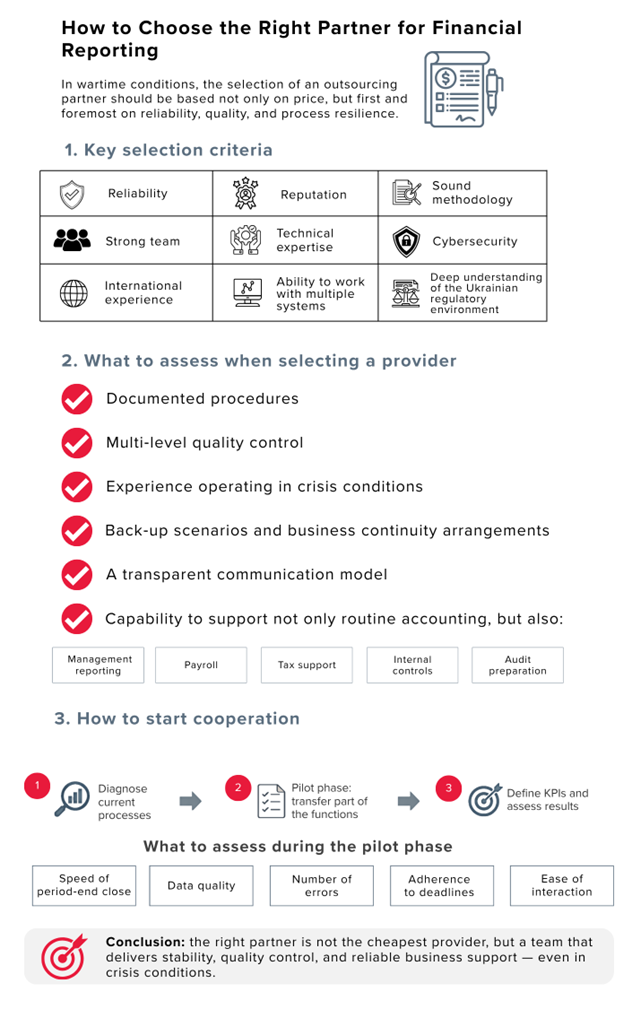
In wartime conditions, selecting an outsourcing partner cannot be based on price alone. Reliability, reputation, methodology, team capacity, technical expertise, cybersecurity, international experience, ability to work with multiple systems, and a deep understanding of the Ukrainian regulatory environment become far more critical.
Companies should assess whether the provider has documented procedures, multi‑level quality control, experience supporting businesses in crisis conditions, back‑up scenarios, a transparent communication model, and the capability to support not only routine accounting, but also management reporting, payroll, tax support, internal controls, and audit readiness.
“An effective approach is to begin with a diagnostic of existing processes or a pilot phase, such as transferring part of the functions, setting KPIs, and evaluating the speed of period‑end closing, data quality, error levels, adherence to deadlines, and ease of collaboration,” — comments Victor Nevmerzhitsky, Tax & BSO Partner.
Outsourcing as part of Ukraine’s recovery
Ukraine’s recovery requires more than the physical reconstruction of infrastructure. It also depends on strong management systems, transparent finances, investor confidence, the ability to work effectively with international partners, and resilient business models.
Professional outsourcing can become one of the practical enablers of this recovery. It helps companies retain control over their finances, reduce operational risks, maintain compliance, improve the quality of reporting, and free up management time for strategic priorities — including market expansion, fundraising, business model transformation, digitalisation, and active participation in the country’s recovery efforts.
In the Ukrainian context, outsourcing is not about shifting problems outside the organisation. It is about building a more resilient operating model that allows a business to continue operating, reporting, paying salaries, meeting its obligations, and making informed decisions even amid high levels of uncertainty.
When outsourcing is implemented with the right governance model, transparent rules, high‑quality communication, and a strong professional partner, it becomes more than a support function. It becomes an integral part of business resilience.
How BDO in Ukraine can support your business
BDO in Ukraine helps companies build resilient financial, tax, accounting, payroll, digital, and IT functions in the context of war, energy instability, talent shortages, and increasing requirements for business transparency.
We can support businesses through full outsourcing of specific functions, as well as through targeted reinforcement of in‑house teams during periods of peak workload, transformation, relocation, scaling, or preparation for audit, investment, or international partnerships.
BDO in Ukraine can provide full or partial accounting outsourcing, including primary documentation preparation, transaction processing, period‑end closing, reconciliations, preparation of financial information, and support for day‑to‑day accounting operations.
This enables companies to reduce dependency on a single key individual, ensure continuity of accounting processes even in the event of power outages, staff relocation, or workforce changes, and improve the quality and controllability of financial data.
We support companies in payroll calculation, including salaries, taxes, vacation pay, sick leave, compensation, payments to mobilised employees, and other payroll‑related processes.
In wartime conditions, timely and accurate payroll processing has not only financial, but also reputational and social importance. Outsourcing this function helps reduce the risk of errors, delays, data loss, and dependency on a single specialist.
BDO in Ukraine supports businesses in meeting their tax obligations, preparing and filing tax reporting, controlling deadlines, monitoring legislative changes, assessing tax risks, and assisting companies in their interactions with regulatory authorities.
This support is particularly important in an environment of constant regulatory change, wartime restrictions, infrastructure disruptions, and increased scrutiny of the quality and documentation of business transactions.
A separate area of support relates to processes associated with the military records of employees. We assist companies in structuring the relevant processes, verifying the availability of required documentation, supporting internal procedures, coordinating the tracking of changes, and reducing the risk of non‑compliance with legislative requirements.
For employers, this area has become part of a broader framework encompassing human resources management, payroll processing, compliance, and workforce risk management.
BDO in Ukraine supports companies in preparing financial statements in accordance with International Financial Reporting Standards (IFRS), transforming reporting from local standards to IFRS, preparing disclosures, performing consolidations, addressing complex accounting matters, and preparing for audit.
High‑quality IFRS reporting becomes critically important for companies working with international investors, banks, donors, parent entities, or those preparing to raise financing.
Management reporting
We help companies prepare management reporting that provides leadership with clear visibility over liquidity, profitability, costs, receivables, margins, cash flows, and key business performance indicators.
In wartime conditions, management reporting must go beyond formality and be genuinely practical. It should enable rapid decision‑making, highlight risks, and support effective business management in an environment of high uncertainty.
Outsourced digital and IT functions
BDO in Ukraine can also support businesses in the digitalisation of financial, accounting, tax, HR, and management processes. This may include reporting automation, the implementation of digital workflows, system integration, analytical dashboards, ERP solution support, document flow optimisation, access management, cyber hygiene, and IT support for specific business functions.
For companies that do not have a sufficiently developed in‑house IT team, or that need to quickly strengthen their digital capabilities, outsourcing digital and IT functions provides access to the required expertise without the need to build a large permanent internal team.
Integrated outsourcing model
The greatest business impact is achieved through an integrated outsourcing model, where accounting, payroll, tax compliance, military records management, IFRS reporting, management reporting, internal controls, and digital and IT support operate not in isolation, but as a unified system.
Under this model, a company does not merely receive individual services but gains a more resilient operational platform — with clearly defined processes, controlled data, distributed accountability, back‑up resources, regular reporting, and enhanced readiness for audits, inspections, fundraising, and collaboration with international partners.
BDO in Ukraine supports businesses in maintaining continuity of critical functions, reducing operational and compliance risks, improving the quality of financial data, and freeing up management time for strategic priorities — including growth, transformation, and participation in Ukraine’s recovery.
Contact our team for a consultation by completing the form below.