





In light of the ongoing war and large-scale mobilisation in Ukraine, the requirements for organising and maintaining military records at enterprises have become significantly more stringent. Inspections by the Territorial Centres of Recruitment and Social Support (TCR and SS) are now conducted on a regular basis, while administrative fines for non-compliance have increased substantially. Below you will find a detailed overview of the key legal requirements and practical guidance.
Have you received correspondence from the TCR and SS regarding a planned inspection?
The TCR and SS scheduled an inspection at your company? We believe you will find this material useful. The article outlines the procedure for conducting inspections of military registration at enterprises, explains their types and frequency, describes key preparation requirements and the potential consequences of non-compliance, and provides practical recommendations based on current inspection practice.
Introduction
Inspections conducted by the TCR and SS are becoming increasingly relevant for enterprises, as their results directly affect compliance with military registration and mobilisation legislation. In this context, professional support during such inspections is an essential element of an enterprise’s legal security, as it not only facilitates the timely identification and remediation of potential violations, but also significantly reduces the risks of fines and other regulatory sanctions.
It should be noted that timely and professional preparation for inspections by the TCR and SS ensures that established procedures are properly followed and enables enterprises to avoid administrative and financial liability. Therefore, we recommend conducting an internal audit of the state of military registration at the enterprise at least once a year, as well as immediately prior to an inspection by the TCR and SS.
As part of preparations for the inspection, we recommend conducting a comprehensive review of existing military registration documentation and related organisational processes. All internal documents relating to military registration must be reviewed and updated to comply with the current requirements of Ukrainian legislation. If a company is preparing for the inspection on its own, it is recommended to consult specialists on recent legislative changes and practical aspects of inspections during the preparation process.
Conducting of inspections by TCR and SS is regulated by the Procedure for Organizing and Maintaining Military Registration of Conscripts, Reservists, and Military Obligated Citizens, which was approved by Resolution of the Cabinet of Ministers of Ukraine No. 1487 (hereinafter referred to as Procedure No. 1487) dated 30 December 2022.
Types of inspections of military registration status
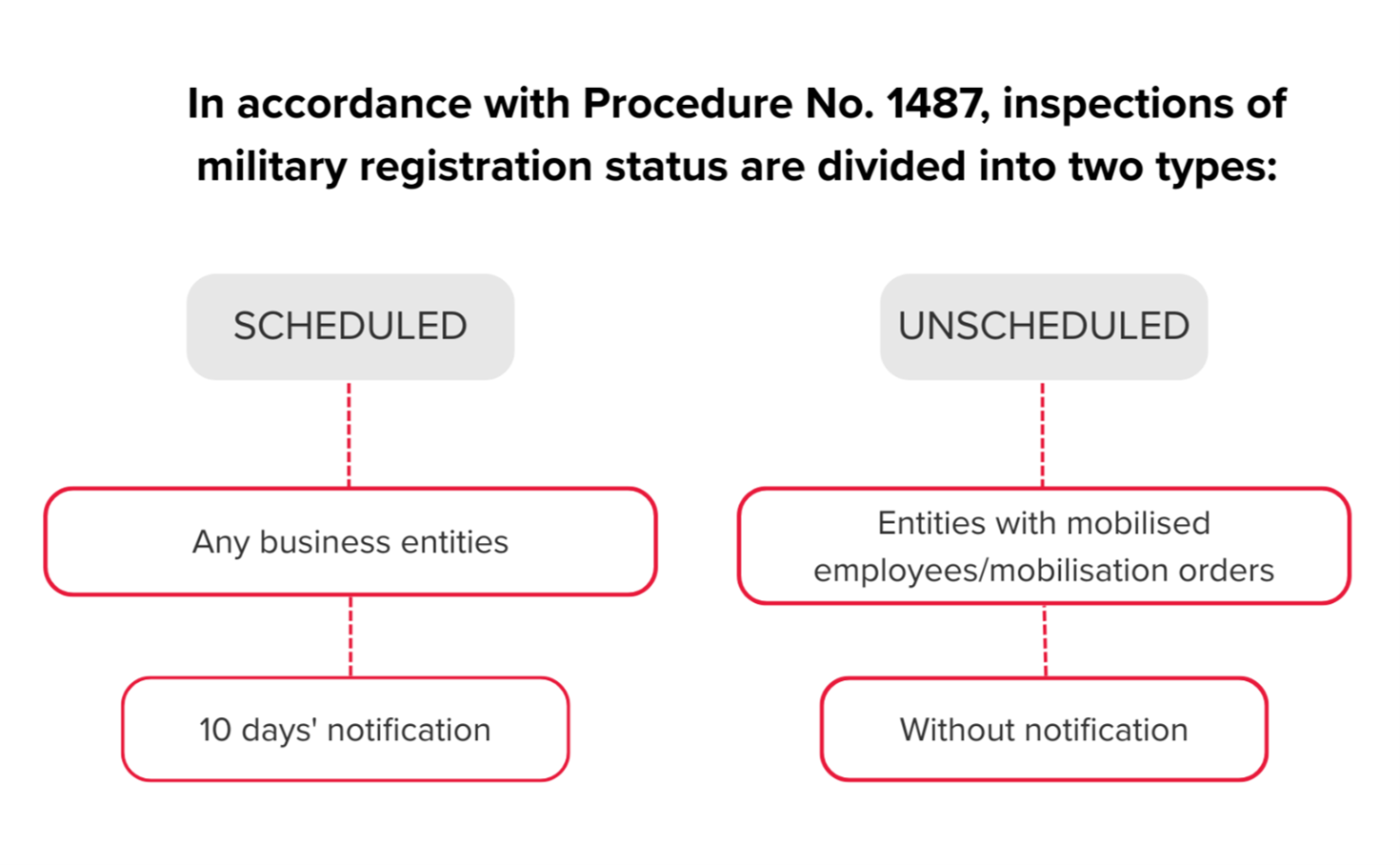
In accordance with Procedure No. 1487, inspections of military registration status are divided into two types:
- Scheduled (including documentary*):
- Carried out in relation to any business entities
- Mandatory notification of the inspection 10 days in advance.
- Unscheduled:
- Carried out in relation to business entities that employ conscripts who are reserved for the enterprise and/or have mobilisation orders
- No notification of such inspections is sent.
* A documentary check is essentially a non-field inspection conducted when it is impossible to carry out the planned checks of the organisation and maintenance of military records due to circumstances beyond the enterprise’s control. Such an inspection is carried out by sending written requests to enterprises, institutions, and organisations for information, the list of which is specified in clause 17 of Appendix 31 to Procedure No. 1487.
Who conducts inspections and when
In accordance with Procedure No. 1487, district state administrations, district state administrations in the cities of Kyiv and Sevastopol, and executive bodies of city councils conduct annual inspections of military registration at local government bodies, enterprises, institutions, and organisations located within their administrative-territorial unit, in accordance with their approved plans and in cooperation with district (city) territorial recruitment and social support centres.
Usually, plans for such inspections are published on the websites of local executive authorities (for example, in Kyiv, on the websites of district state administrations), listing the organisations located within a particular administrative-territorial unit and the specific months of the year in which the inspection is scheduled. According to paragraph 82 of Procedure No. 1487, the inspection of the organisation and maintenance of military records of conscripts, persons liable for military service and reservists is conducted in relation to the matters specified in Appendix 31. The inspection-related issues must be communicated to state bodies, local self-government bodies, enterprises, institutions and organisations included in the relevant inspection plans no later than 10 days before the start of the inspection.
In doing so, it is recommended to periodically check whether the enterprise is included in the inspection plan to ensure proper advance preparation.
If it is impossible to implement the relevant plan for inspecting the state of an enterprise and maintaining military records due to circumstances beyond the enterprise’s control, a documentary check may be carried out by sending a written request for information to the enterprise.
In accordance with paragraph 84 of Procedure No. 1487, the chair of the commission or his/her deputy conducting the inspection of military registration shall be presented with a duly executed order authorising the conduct of the inspection of military registration (Appendix 32 to Procedure No. 1487), and the work plan shall be approved accordingly. Before the start of the inspection, the enterprise has the right to request that representatives of the TCR present such an order and their official identification documents.
Frequency of inspections:
- Once a year — if the company has reserved employees or employees who have received mobilisation orders
- Once every four years — if the company does not have reserved employees or employees who have received mobilisation orders
Period of inspection
Procedure No. 1487 does not specify the period for which the inspection is conducted. In practice, inspections are usually conducted for the period starting in 2023, since Procedure No. 1487 came into force on 5 January 2023. However, a shorter period may also be subject to inspection.
How to properly prepare for an inspection by the TCR and SS
Now that we have clarified the types and frequency of inspections, we invite you to review the legal requirements and our practical recommendations for preparing for an inspection.
It is important to note that preparation for an inspection should not be a one-time reaction, but a systematic and continuous process of ensuring an adequate level of military registration. The enterprise is obliged to guarantee the completeness and accuracy of all information reflected in personal military registration lists, personnel documents and tax reporting.
First, it is necessary to monitor the dates of scheduled inspections in advance in order to allow enough time for thorough preparation.
In addition, given that, in accordance with Procedure No. 1487, the commission that inspects the status of military registration may also include representatives of other state bodies (State Labour Service, State Tax Service), which poses an increased risk for the enterprise, it is advisable to ensure proper organisation of cooperation in advance and readiness to provide the requested documents and information.
In preparation for the 2026 inspection, we recommend first focusing on the changes that have occurred over the past two years:
- The reserve ID has become the primary form of military registration document
- Updated lists of personal military registration and other appendices to the Procedure for Organizing and Maintaining Military Registration of Conscripts, Reservists, and Military Obligated Citizens, approved by Resolution of the Cabinet of Ministers of Ukraine No. 1487 (hereinafter referred to as Procedure No. 1487) dated 30 December 2022
- New requirements have been established for the notification of employees regarding summons to the TCR, and a new procedure for the notification of summons/serving of summons.
- Changes have been made to the composition of the commission that checks the status of military registration at the enterprise (representatives of the State Labour Service and the State Tax Service have been added).
- Changes have been made to the time limits for bringing to justice for violations of legislation on defence, mobilisation preparation and mobilisation.
What does the TCR and SS check?
As mentioned above, a specific list of inspection questions is provided in Appendix 31 to Procedure No. 1487. In particular, the organisation of military registration for conscripts, reservists, and military obligated citizens, the state of military registration, the timeliness of changes to lists and records, the state of methodological and technical support for military registration measures, the organisation and status of reservations, as well as the availability and content of mandatory military registration documents are subject to inspection.
Regarding the list of documents that the TCR may request for inspection, it should be noted that this list is not exhaustive. Usually, the following documents may be requested during the inspection:
- Regulations of the structural unit responsible for military registration (if established)
- Job descriptions for persons responsible for military registration
- Order of the head appointing persons responsible for military registration
- Proof of informing employees liable for military service about the Rules of Military Registration
- Order regarding determining the need for advanced training of the responsible person
- Lists of personal military records (Appendix 5 to Procedure No. 1487)
- Operational record sheet (Appendix 12 to Procedure No. 1487)
- Proof of filing notifications using Appendices No. 1 and 4 with the TCR
- Copies of military registration documents (MRD) of all conscripts, military personnel, and reservists (paper copies or printouts from Reserve+)
- Schedule for verifying personal military registration lists against their military registration documents
- Journal (Appendix 9 to Procedure No. 1487)
- Order regarding the status of military registration for the past year and tasks for the next year
- Staffing table
- Reports on the results of actions taken following preliminary inspections
- Work plan for military registration
- Proof of explanatory work with employees liable for military registration
- Proof of reconciliation of personal military registration lists
- Acknowledgment log
Attention is paid to the availability of copies of employees’ military registration documents, the reflection of relevant information in military registration lists, as well as the availability of proof and confirmation of timely submission of notifications regarding changes in data and correspondence with the TCR and SS. All the above documents must be organised, updated, and cross-checked with each other. Together, they confirm the proper organisation of military registration at the enterprise in accordance with the requirements of Procedure No. 1487.
In addition, as practice shows, representatives of the TCR and SS often make requests during inspections that are not directly stipulated in legislation. Such requests are not provided for by law, but may be reflected in the Inspection Report as observations or shortcomings:
- Personal military records are maintained in electronic form, but are not saved in a separate file after each change
- Personal military records must be organised in alphabetical order
- Personal military records are not correctly registered with the records management service
- Those responsible for maintaining military records must perform internal reconciliation within the timeframes approved by the reconciliation schedule and document the results
- Notifications of changes to record data and other documents sent to the TCR must be sent exclusively by registered mail with a description of contents
- The reconciliation schedule must be formally approved by order
- A military registration work plan must be formally approved
- All enterprises must issue an order regarding the status of military registration and tasks for the following year
- Agreement with the TCR and SS on appointing a person responsible for military registration
- Appointment of a deputy responsible for military registration
It should be noted that some of the requirements of the TCR and SS are very strict, but some are quite reasonable, as they protect the interests of the employer. For example, sending notifications of changes to registration details and other documents to the TCR and SS exclusively by registered mail with a description of contents. After all, it is the description of contents that serves as proper confirmation that certain documents were sent to the TCR and SS.
In doing so, a significant part of the documents requested by representatives of the TCR and SS during inspections is not expressly prescribed by law. However, we do not recommend entering into disputes with representatives of the TCR and SS during an inspection. It is advisable to cooperate with them and provide the documents requested for inspection, provided that such requests are reasonable and directly related to the subject matter of the inspection. Please note that failure to cooperate with the TCR and SS during an inspection at an enterprise may result in significant administrative fines being imposed on the company’s management (ranging from UAH 34,000 to UAH 59,500), increased control measures, unscheduled inspections, as well as more thorough verification of the legality of employee reservations and the delivery of summonses to employees.
In addition, given that representatives of the State Labour Service of Ukraine and the State Tax Service of Ukraine may now be members of the inspection commission, it is reasonable to expect that they may be interested in personnel documentation and tax reporting (including Form 4DF, among others). Such access would enable them to assess the completeness and accuracy of personnel records, as well as the correctness of the registration and accounting of persons liable for military service in the employer’s records.
As previously noted, Resolution of the Cabinet of Ministers of Ukraine No. 892 of 16 July 2025 “On Amendments to the Procedure for Organizing and Maintaining Military Registration of Conscripts, Reservists, and Military Obligated Citizens” introduced amendments to Procedure No. 1487. These amendments provide that, in addition to the representatives specified in paragraph 84 of Procedure No. 1487, the commission responsible for verifying the status of military registration at an enterprise may also include representatives of:
- Interregional territorial bodies of the State Labour Service (within the limits of their powers)
- Territorial bodies of the State Tax Service.
Unlike the TCR and SS, the State Labour Service of Ukraine and the State Tax Service of Ukraine have the practical capacity to identify inconsistencies between the information provided by an employer and the actual circumstances. For example, an employer may take the position that, in the absence of employees, there is no obligation to maintain military records. In doing so, the TCR and SS may take a different view, arguing that the company is operating and that, in their assessment, such activity would be impossible without the involvement of men.
However, the TCR and SS does not have effective instruments to detect concealed (undeclared) employment relationships. Moreover, an employer will not voluntarily disclose to the TCR and SS either civil law contracts or information about sole proprietors who perform work or provide services for the company. Such non-disclosure is lawful and constitutes a legitimate practice on the part of the employer.
However, the State Labour Service of Ukraine and the State Tax Service of Ukraine have the tools and authority to identify hidden employment relationships. During inspections, the State Tax Service verifies the proper conclusion of employment contracts and, if unregistered employment is detected, treats this as a violation and forwards the findings to the State Labour Service for consideration and imposition of fines. In addition, the tax authority may independently identify contractors and, together with the State Labour Service, assess whether such relationships constitute disguised employment. The TCR and SS will then act strictly within the scope of its statutory powers.
What can be corrected before an inspection to avoid issues and minimise the risk of penalties:
- Appoint (or reappoint) a person responsible for military records and establish the relevant additional payment (allowance)
- Prepare the lists of personal military records (Appendix 5 to Procedure No. 1487) and operational records (Appendix 12 to Procedure No. 1487) as of 01.01.2024, 01.01.2025 and 01.01.2026; sign and register these lists in accordance with the procedure and keep them in a single file together with copies of military registration documents
- Prepare an order establishing the need for advanced training of the responsible person “by 1 October”
- Ensure that the responsible person completes professional development at least once every five years (inspections increasingly emphasise that responsible persons should have already completed such training and obtained the relevant certificate, since Procedure No. 1487 was approved in 2023).
- Display the Rules of Military Registration (Appendix 2 to Procedure No. 1487) and other regulatory acts governing military registration in a prominent location, and keep them updated on the military registration stand
- Familiarise conscripts, persons liable for military service, and reservists with the Rules of Military Registration upon employment, ensuring they sign to confirm acknowledgement
- Approve schedules for internal and external reconciliation of accounting data
- Conduct internal reconciliation of personal military records with the corresponding military registration documents
- Reconcile personal military records with data from the TCR and SS at the enterprise’s place of registration.
List of violations subject to fines
Below is a list of the most common violations for which the TCR and SS impose fines following inspections:
- Hiring a person subject to military service without a military registration document
- Failure of the enterprise to maintain military records
- Failure to appoint a person responsible for maintaining military records
- Failure to comply with the orders of the TCR and SS
- Failure to report the arrival of conscripts and persons liable for military service to the TCR and SS
- Absence of a logbook recording the results of inspections of military registration
- Absence of personal military registration lists
- Failure to familiarise employees with the Rules of Military Registration
- Absence of an order appointing a person responsible for military registration
- By order of the manager, the director is appointed responsible for military registration, but in practice this is done by the accountant
- By order of the manager, the director is appointed responsible for maintaining military records, but in practice this is done by the personnel department inspector
- The order appointing the person responsible for maintaining military records does not specify a deputy to act during their absence.
- By order of the manager, persons who are not employees of the personnel department are appointed responsible for military registration (for example, an occupational safety engineer) even though the company has a personnel department)
- Orders appointing a person responsible for maintaining military records are not registered in the office records
- The order appointing the responsible person does not specify additional remuneration for maintaining military records.
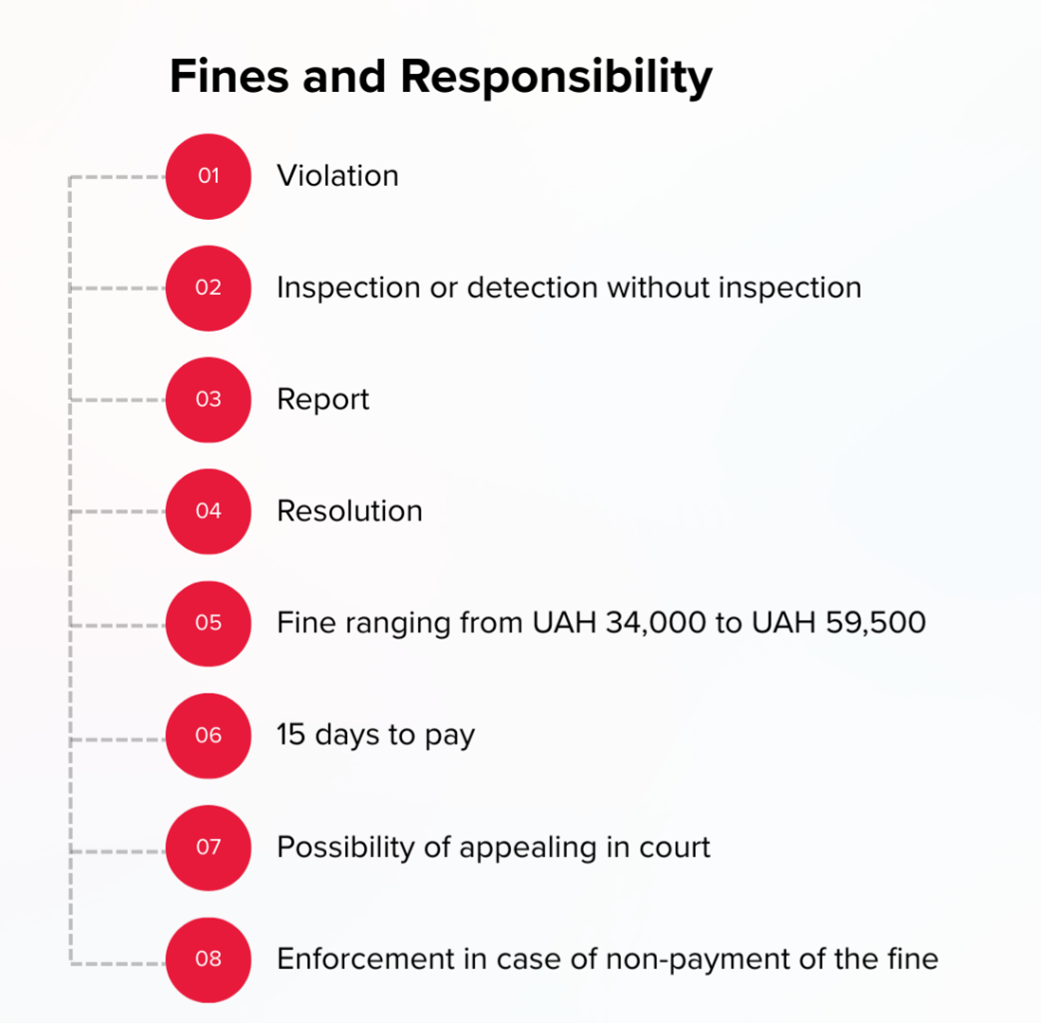
It should also be noted that the TCR and SS may impose fines both following inspections of military registration and without conducting such inspections. This is due to the absence of legislative provisions specifying that fines may be imposed only based on the results of inspections.
A business can be fined without an inspection of military registration for:
- Failure to notify or follow the procedure for informing conscripted employees of their summons to the TCR and SS
- Hiring conscripts, conscripted persons, and reservists who are not registered for military service
- Failure to notify conscripts, conscripted persons, and reservists of their summons to the TCR and SS
- Obstructing the timely arrival of conscripts, persons liable for military service, and reservists at assembly points and conscription offices
- Delayed submission of documents required for the military registration of conscripts, persons liable for military service, and reservists, or failure to submit such information
- Failure to notify the appointment of a person responsible for maintaining military records.
The TCR and SS may also impose fines for other violations that can be identified without an inspection. However, in most cases, company officials are held administratively liable for violations that:
- Arise from failure to comply with the direct requirements of the TCR and SS (for example, failure to follow or improperly fulfilling orders regarding notifications, or failure to provide requested information about conscripts, persons liable for military service, and reservists whose personal military records are maintained by the enterprise)
- Relate to obligations tied to specific calendar dates or periods (for example, failure to conduct reconciliation with the TCR and SS for the relevant year, or failure to provide information on the availability and technical condition of vehicles and equipment, as well as on citizens working with such vehicles and equipment at the enterprise).
Formalisation of inspection results
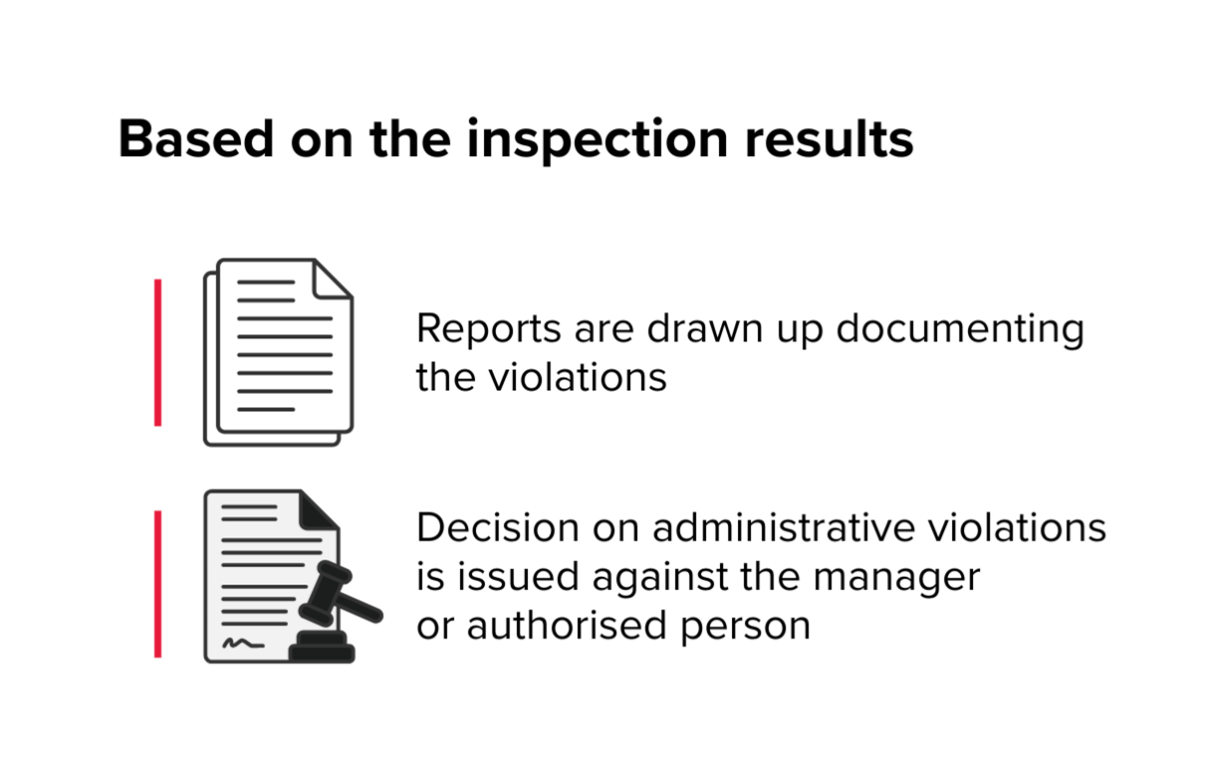
Based on the inspection results:
- Reports are drawn up documenting the violations
- Decision on administrative violations is issued against the manager or authorised person.
Based on the inspection results, reports are drawn up and approved by the heads of district, Kyiv and Sevastopol state administrations, and city council chairpersons, who send them to enterprises as well as to regional and district (city) TCR and SS offices within 20 days of the inspection’s completion for response and action in accordance with the law.
Afterwards, the enterprise must eliminate all identified deficiencies and inform the head of the inspecting authority of the measures taken within 30 days of receiving the inspection results.
If a violation is detected during an inspection of military registration records, cases of administrative violations of military registration rules are considered by the heads of the TCR and SS (Article 235 of the Code of Administrative Offences). They may also impose administrative fines on responsible officials.
The results of the inspection are entered by TCR and SS representatives into the logbook of military registration inspection results, which is kept at the enterprise in accordance with Appendix 9 to Procedure No. 1487. The logbook also records the manager’s decision on which deficiencies must be corrected. Based on the measures taken, the person responsible for maintaining military records makes a note confirming that the identified deficiencies have been addressed. In addition, under paragraph 72 of Procedure No. 1487, the results of these measures and the verification of military registration must be considered when approving the order on the status of military registration for the past year and the tasks for the following year.
Time limit for imposing fines
Administrative penalties for offences committed during a special period, as provided in Articles 210 and 210‑1 of the Code of Administrative Offences, may be imposed within three months of the date of discovery, but no later than one year from the date of the offence (Article 38 of the Code of Administrative Offences).
A common question arises: is the fine imposed for all offences collectively or separately for each offence?
- If violations are detected during an inspection, a single administrative case is considered, and one fine is imposed for all violations
- If violations are detected outside an inspection but are considered within a single administrative case, one fine is imposed for all violations
- If violations are detected outside an inspection, there will be as many fines as there are administrative cases, meaning a fine may be imposed for each violation detected and case considered.
A person who commits an administrative offence is liable under the law in force at the time and place of the offence (Article 8 of the Code of Administrative Offences). It should be noted that laws that mitigate or abolish liability for administrative offences have retroactive effect and therefore apply to offences committed before their enactment. Conversely, laws that establish or increase liability do not have retroactive effect. As a result, for violations committed before the law increasing fines came into force, the previous amounts apply. For example, for violations of legislation on defence, mobilisation preparation, and mobilisation, the maximum fine was UAH 8,500. For violations committed after the law came into force (09.05.2024), the new increased fines are applicable.
Who can be fined
A party liable for improper military registration is an official of the enterprise, namely the manager or the person appointed to maintain military records.
A legal entity itself is not subject to administrative liability for violations of the military registration procedure.
Who considers cases on imposing fines
Cases are considered by the head of the TCR and SS (Article 235 of the Code of Administrative Offences).
What is the current fine amount?
According to Article 210-1 of the Code of Administrative Offences, the fine for officials ranges from 2,000 to 3,500 NMW (UAH 34,000–59,500).
The amount of the fine within the above limits is determined by the head of the TCR at his or her discretion: the criteria are not regulated by law.
If there is disagreement with the TCR’s decision, it can be appealed in court.
Deadlines for payment of fines
The fine must be paid by the offender no later than 15 days from the date of delivery of the decision imposing the fine. In the event of an appeal, the fine must be paid no later than 15 days from the date of notification that the appeal has been dismissed (Article 307 of the Code of Administrative Offences).
Consequences of non-payment of a fine within 15 days
If the fine is not paid within the specified period, the decision is transferred to the enforcement service for collection. In this case, the fine amount is doubled, and an enforcement fee is also charged (Article 308 of the Code of Administrative Offences).
Conclusions
In summary, inspections of the organisation and maintenance of military records at enterprises are a systematic tool for state control over compliance with legislation in the field of defence and mobilisation preparedness. Given the expansion of regulatory powers, updates to the legal framework, and increased administrative liability, proper preparation for such inspections is particularly important for management and persons responsible for military registration.
Preparation for TCR and SS inspections is essential to ensure proper organisation of military registration at the enterprise and to pass the inspection without violations. Timely updating of documents and implementation of effective internal procedures ensures compliance with legal requirements and helps minimise the risk of penalties. A comprehensive approach to preparation—including training for responsible persons, establishing clear schedules for record reconciliation, and conducting regular internal audits—reduces the likelihood of violations.
Effective preparation for inspections should be carried out continuously and include internal auditing of military registration documents, timely updating of registration data in lists, proper execution of administrative acts, organisation of interaction with the TCR and SS, and monitoring compliance with notification procedures. Attention should also be given to the systematisation of documents and the recording of all communications with the TCR and SS.
It is also advisable to systematically monitor changes in regulatory acts, regularly update military registration documents, and ensure proper interaction with the TCR and SS. These measures reduce legal risks, enhance legal security for businesses, and support sustainable development in a dynamic legal environment.
Thus, a comprehensive, proactive, and legally balanced approach enables companies not only to minimise the risk of fines and additional control measures, but also to ensure the company’s legal security amid increased requirements for compliance with mobilisation legislation.
Thanks to the tips outlined above, companies can confidently prepare for inspections. However, above all, the enterprise must strictly comply with the provisions of Procedure No. 1487.